
Prephenate-based hydroxylation and inhibitor exploration
About the project
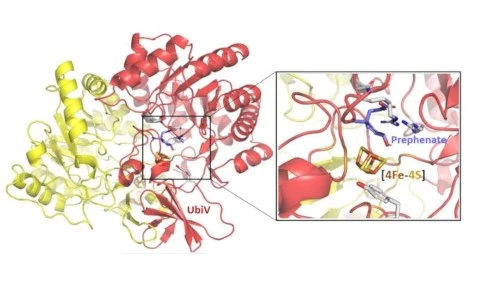
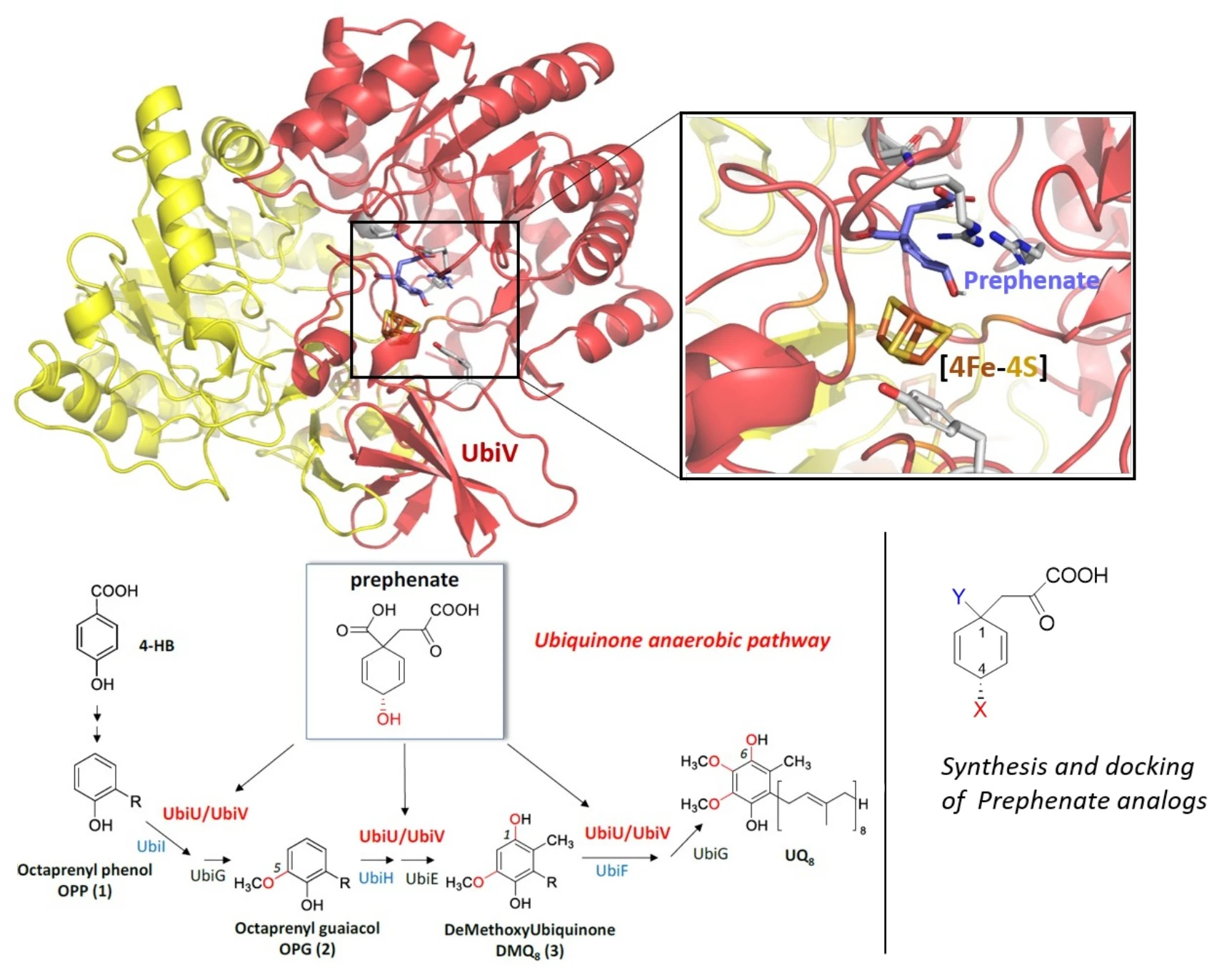
The team Chemistry of Biological Processes led by Prof. Marc Fontecave at the Collège de France recently discovered a novel bacterial enzymatic system, UbiU-UbiV, enabling ubiquinone biosynthesis in anaerobic conditions. This heterodimeric complex contains two [4Fe-4S] clusters and uses prephenate as the oxygen donor - marking the first time an organic molecule has been shown to donate an oxygen atom in a biological hydroxylation reaction.
This unique hydroxylation mechanism raises questions about prephenate activation and the role of the iron-sulfur clusters. It also offers a promising new antibiotic target, especially against bacteria like Pseudomonas aeruginosa that depend exclusively on ubiquinone for their pathogenicity.
The project, in collaboration with Dr. Nicolas Chéron at Laboratoire de Biochimie Théorique at IBPC(previously member of the Theoretical Chemistry group, ENS-PSL), aims to develop inhibitors targeting UbiU-UbiV using a mixed experimental/computational approach. Prephenate analogs will first be syntesised and their dissociation constant (Kd) from UbiU-UbiV will be characterised using isothermal titration calorimetry. In parallel, these molecules will be docked in an AlphaFold model, and their Kd will be accurately computed with alchemical transformations. Integrative approach will provide a model to predict the Kd for unknown molecules. The computational workflow will then be applied on new rationally-designed molecules, helping the choice of candidates to be synthesized.
Overall, this will allow the optimization of ligands to provide more effective analogs targeting UbiU-UbiV, ultimately contributing to the development of new antibacterial therapies.
This unique hydroxylation mechanism raises questions about prephenate activation and the role of the iron-sulfur clusters. It also offers a promising new antibiotic target, especially against bacteria like Pseudomonas aeruginosa that depend exclusively on ubiquinone for their pathogenicity.
The project, in collaboration with Dr. Nicolas Chéron at Laboratoire de Biochimie Théorique at IBPC(previously member of the Theoretical Chemistry group, ENS-PSL), aims to develop inhibitors targeting UbiU-UbiV using a mixed experimental/computational approach. Prephenate analogs will first be syntesised and their dissociation constant (Kd) from UbiU-UbiV will be characterised using isothermal titration calorimetry. In parallel, these molecules will be docked in an AlphaFold model, and their Kd will be accurately computed with alchemical transformations. Integrative approach will provide a model to predict the Kd for unknown molecules. The computational workflow will then be applied on new rationally-designed molecules, helping the choice of candidates to be synthesized.
Overall, this will allow the optimization of ligands to provide more effective analogs targeting UbiU-UbiV, ultimately contributing to the development of new antibacterial therapies.
Teams involved
Chemistry of Biological Processes - Collège de France
Murielle Lombard
Theoretical Chemistry - ENS-PSL
Nicolas Chéron